MP3 squeezed music onto early players in the 1990s, and AAC arrived in 1997 to do the same job with fewer bits. MPEG-1 Audio Layer III and Advanced Audio Coding both use lossy compression, so the real contest is quality per bitrate against compatibility. A good AAC encoder wins on quality: in a public blind test from 2014, Apple's AAC scored 4.40 out of 5 at 104 kbps, while an MP3 scored 4.24 at 136 kbps. MP3 wins on reach.
MP3 is six years older, and AAC's longer and shorter coding blocks explain its edge. The encoder you use can matter more than the format, AAC holds up better at low bitrates, and the iTunes Store, Spotify and YouTube lean on it. Your devices settle the verdict.
Are AAC and MP3 Both Lossy Audio Formats?
Yes, AAC and MP3 both discard the sounds the ear is least likely to notice, so neither file can be turned back into the original recording. Both encoders use auditory masking, where a louder sound hides a quieter one nearby. Fraunhofer developed most of MP3, short for MPEG-1 Audio Layer III. Dolby, AT&T, Fraunhofer and Sony developed Advanced Audio Coding as MP3's successor.
Each format has its own guide: what AAC is and what MP3 is. Lossless formats such as FLAC and ALAC keep every bit, which the lossless audio guide explains.
When Were MP3 and AAC Released?
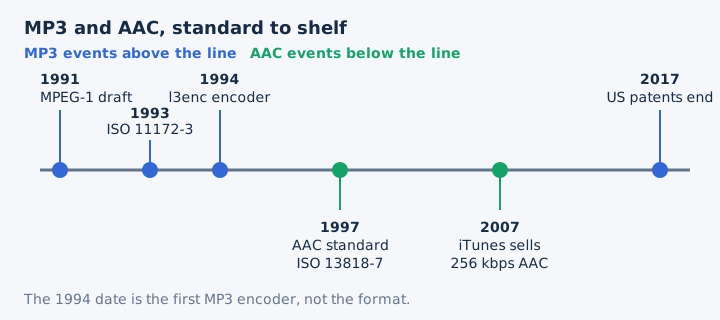
MP3 came first: its MPEG-1 draft was public on 6 December 1991, and the ISO standard was published in 1993. MPEG declared AAC an international standard in April 1997, six years after the first MP3 draft. ISO/IEC 11172-3 sets out the MP3 format, and ISO/IEC 13818-7 sets out AAC. Six dates trace the two formats from paper standard to everyday files.
- 1991: the MPEG-1 draft with Layer III audio went public on 6 December.
- 1993: ISO/IEC 11172-3 published MPEG-1 Audio, which defines MP3, as a standard.
- 1994: Fraunhofer released l3enc, the first software MP3 encoder, on 7 July.
- 1997: AAC became an international standard as ISO/IEC 13818-7, part of MPEG-2.
- 2007: the iTunes Store started selling DRM-free iTunes Plus songs as 256 kbps AAC.
- 2017: MP3 became substantially patent-free in the United States on 16 April.
How Does AAC Compress Sound Differently From MP3?
AAC uses a pure MDCT filter bank with longer and shorter blocks than MP3's hybrid design, so it codes steady tones more efficiently and sharp transients more accurately. The modified discrete cosine transform turns sound into frequency bands, and a psychoacoustic model then drops the masked parts in both encoders. The block sizes show where AAC's efficiency comes from.
| Design point | AAC | MP3 |
|---|---|---|
| Transform | Pure MDCT | Hybrid MDCT and FFT |
| Block for steady sound | 1,024 or 960 samples | 576 samples |
| Block for transients | 128 or 120 samples | 192 samples |
| Low-bitrate profiles | HE-AAC, HE-AAC v2 | None |
A longer block catches more of a held note in one pass. A shorter block pins a drum hit in time more precisely. AAC-LC, the Low Complexity profile, is the one most files use. HE-AAC and HE-AAC v2 add tools for low bitrates.
How Do AAC and MP3 Compare Feature by Feature?
AAC wins on quality per bit, sample rates and channels, while MP3 wins on reach and has been patent-free in the US since 2017. This comparison table sets eight attributes side by side, with figures from MDN's audio codec guide and the MPEG standards.
| Attribute | AAC | MP3 |
|---|---|---|
| Compression | Lossy | Lossy |
| Standard | 1997, MPEG-2 and MPEG-4 | 1991 to 1993, MPEG-1 and MPEG-2 |
| Bitrate | Any, up to 512 kbps | 32 to 320 kbps |
| Sample rate | 8 to 96 kHz | 16 to 48 kHz |
| Channels | Up to 48 | 2, or 5.1 in MPEG-2 |
| File extension | .m4a or .aac | .mp3 |
| Patents | Licensed until 2028 | Free since 2017 (US) |
| Plays on | Modern devices | Nearly every device |
The patent row tells you who pays, not whether you can use the format. The questions below take the attributes that change a real choice one at a time.
Which Sounds Better at the Same Bitrate, AAC or MP3?
AAC usually sounds better than MP3 at the same bitrate, and the gap is widest at 128 kbps and below. AAC reaches hi-fi transparency at about 128 kbps VBR, while MP3 needs 256 to 320 kbps for its high-quality range. At high bitrates the gap narrows, and both formats can sound like the source to many listeners.
The encoder changes the result too, and in one public test it mattered more than the format did. The test results further down show how large that effect can be. For what makes a file sound good in the first place, see the audio quality guide.
Are AAC Files Smaller Than MP3 Files?
No, not at the same bitrate: a 256 kbps AAC and a 256 kbps MP3 both take 1.92 MB per minute, so AAC saves space only when you choose a lower bitrate for it. Bitrate, not the codec name, sets the file size of every minute.
| Bitrate | Size per minute | 4-minute song |
|---|---|---|
| 128 kbps | 0.96 MB | 3.84 MB |
| 192 kbps | 1.44 MB | 5.76 MB |
| 256 kbps | 1.92 MB | 7.68 MB |
| 320 kbps | 2.4 MB | 9.6 MB |
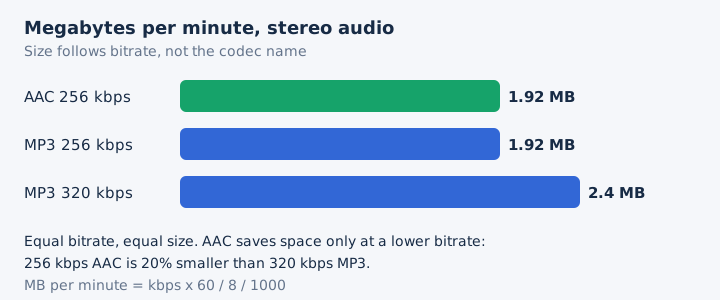
The saving appears when AAC lets you drop a step. A 256 kbps AAC is 20% smaller than a 320 kbps MP3, so 64 GB holds about 8,300 four-minute songs as AAC against about 6,600 as MP3. The audio bitrate guide explains the size formula.
What Bitrates and Sample Rates Can AAC and MP3 Use?
AAC accepts any bitrate up to 512 kbps and sample rates from 8 to 96 kHz, while MP3 stops at 320 kbps and 48 kHz. Each limit below is fixed by the standard, not by the encoder you pick.
- Bitrate: AAC runs at any rate up to 512 kbps stereo; MP3 uses 32 to 320 kbps, or 8 to 160 kbps in MPEG-2 mode.
- Sample rate: AAC covers 8 to 96 kHz; MP3 uses 32, 44.1 or 48 kHz, and 16 to 24 kHz in MPEG-2 mode.
- Minimum for stereo music: MDN recommends 96 kbps at 48 kHz for AAC; MP3 sits mid-range at 128 kbps.
Both formats support VBR, which lets the bitrate rise on busy passages and fall on quiet ones. AAC's ceiling of 512 kbps is 1.6 times MP3's, and its 96 kHz top sample rate is twice MP3's. The sample rate guide explains what those kHz figures capture.
How Many Audio Channels Can AAC and MP3 Carry?
AAC carries up to 48 full-bandwidth channels plus 16 LFE channels, while MP3 carries 2 channels in MPEG-1 mode and 5.1 in MPEG-2 mode. Channels and bitrate are separate attributes, though some guides blur them. MDN names AAC the standard audio format of Blu-ray discs and HDTV, where surround sound tracks are common. Stereo music needs only 2 channels, so either format covers it. The audio codec guide compares channel limits across more codecs.
Will an AAC File Play Everywhere an MP3 Plays?
Almost: Windows, Android, iPhone and VLC play both, but MP3 still reaches more browsers, old players, car stereos and DJ decks. Support splits where patents and age come in.
- Windows Media Player: opens .aac, .adts and .m4a files as well as .mp3.
- Android: decodes AAC LC in .m4a, .mp4, .3gp and .aac, plus MP3 at 8 to 320 kbps.
- iPhone: Apple lists both AAC and MP3 in the iPhone 16 playback formats.
- Firefox: plays AAC only through the operating system, but has MP3 built in.
- DJ decks: every Pioneer unit in the rekordbox list plays MP3.
MP3 stays the de facto standard for digital audio, so it is the safest file for an older car stereo. The full AAC format guide covers how AAC files open on each system.
Do You Need a Licence to Use AAC or MP3?
No, not to play or share the audio: anyone may stream or distribute AAC or MP3 files, but makers of AAC encoders and decoders still need a patent licence, while MP3's patents have expired. Encoder makers license AAC through VIA Licensing, and the last baseline AAC patent runs to 2028. MP3 became patent-free in the EU by 2012 and in the US on 16 April 2017.
Patents are also why Firefox relies on the operating system for AAC playback. The MP3 format guide covers MP3's patent history.
Which File Extensions Hold AAC and MP3 Audio?
MP3 audio nearly always sits in a .mp3 file, while AAC audio usually sits in a .m4a file (an MP4 container) and sometimes in a raw .aac file built from ADTS frames. AAC also appears as .m4b audiobooks, .m4r ringtones, .mp4 video and .3gp files. The MIME types are audio/aac and audio/mp4 for AAC and audio/mpeg for MP3.
M4A names the container, not a separate codec, which the AAC vs M4A comparison covers in depth. MP3 keeps its titles and cover art in ID3 tags, and an ID3v2 frame can embed the album image. The M4A file guide explains how the MP4 container wraps AAC.
What Did a Public Blind Listening Test Find About AAC and MP3?
In a July 2014 public blind listening test of 40 tracks with 38 listeners, Apple's AAC encoder at about 104 kbps scored 4.40 out of 5, above LAME MP3 at about 136 kbps, which scored 4.24. Listeners rated each file on a 1 to 5 scale, where 5 means no audible difference from the original.
| Encoder | Actual bitrate | Mean score |
|---|---|---|
| Opus 1.1 | 107 kbps | 4.65 |
| Apple AAC | 104 kbps | 4.40 |
| Ogg Vorbis | 106 kbps | 4.24 |
| LAME MP3 | 136 kbps | 4.24 |
| FAAC (AAC) | 98 kbps | 2.65 |
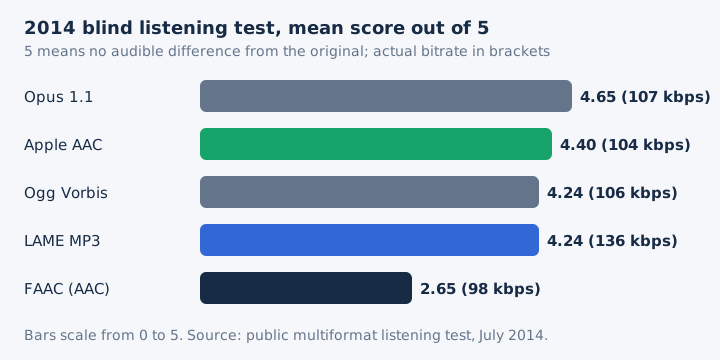
The MP3 used about 31% more bits than Apple AAC (136 against 104 kbps) and still scored 0.16 lower. The test followed the ABC/HR method: each listener rated every lossy file against the lossless original, across 35 music tracks and 5 speech tracks. A minute at those rates is about 0.78 MB for the AAC and 1.02 MB for the MP3.
Does the Encoder Affect Sound Quality More Than the Format?
Often, yes: in the same 2014 test, the FAAC encoder made AAC files that scored 2.65 at 98 kbps, 1.75 points below Apple's AAC encoder at a similar bitrate and well below LAME MP3. MP3 quality depends on the encoder and its settings as well as the bitrate, and the same holds for AAC.
So a well-made MP3 from LAME can beat a poor AAC. The claim that AAC is better assumes a good AAC encoder. The source recording and your playback gear also change what you hear.
Which Handles Low Bitrates Better, AAC or MP3?
AAC does: it stays satisfactory for stereo at about 96 kbps, and its HE-AAC profiles target even lower rates, while MP3 at 32 kbps is fit only for speech. MDN recommends 96 kbps at 48 kHz as the minimum for stereo AAC.
MP3 switches to MPEG-2 mode for its lowest rates, with sample rates of 16 to 24 kHz, which caps the highest frequency at half the sample rate, 12 kHz at 24 kHz. Low bitrates matter when you stream over mobile data or store hours of speech. In the same 2014 test Opus beat both formats at about 100 kbps, and the Opus audio format page covers it.
Which Platforms Choose AAC Over MP3?
Apple's iTunes Store, Spotify's web player and YouTube's upload settings use AAC, while podcast feeds and download stores take both formats. Each platform below names its format in its own help pages.
- iTunes Store: sells DRM-free songs as 256 kbps AAC, starting in 2007.
- Spotify web player: streams AAC at 128 kbps free and 256 kbps on Premium.
- YouTube uploads: recommends AAC-LC or Opus, with 384 kbps for stereo.
- Apple Podcasts: accepts episode audio as either MP3 or AAC.
- Bandcamp downloads: offers MP3 V0, MP3 320 and AAC among other formats.
- AirPods and most Beats: receive sound over the Apple AAC Bluetooth codec.
In 2007 Apple said its 256 kbps AAC files give audio quality indistinguishable from the original recording. That is Apple's own claim about its own encoder.
When Should You Choose AAC Instead of MP3?
Choose AAC when you control the playback devices and want the best sound per megabyte, because a good AAC encoder beats MP3 at equal or lower bitrates. AAC earns its place in these jobs.
- Apple devices: music libraries on iPhone, iPad or Mac play AAC natively.
- Small storage: 64 GB holds about 8,300 songs as 256 kbps AAC, against 6,600.
- MP4 video: the sound track inside an MP4 file is usually AAC already.
- Streaming: uploads and streams at low bitrates keep more detail as AAC.
- Surround: audio beyond 5.1 channels needs AAC, because MP3 stops there.
When Is MP3 the Safer Choice Than AAC?
Choose MP3 when you cannot know what will play the file, because MP3 is the de facto standard that old players, car stereos, DJ decks and every browser read. MP3 wins wherever reach matters more than the last few kilobits.
- Legacy devices: old MP3 players and car stereos may not read AAC.
- DJ decks: every Pioneer deck in the rekordbox list plays MP3 files.
- Shared files: audio sent to clients or strangers opens on nearly any device.
- Web audio: Firefox plays MP3 without help from the operating system.
- Podcast feed: Apple Podcasts accepts MP3, the de facto standard for digital audio.
Pick 192 kbps to 320 kbps for music and 96 to 128 kbps for mono speech.
Is AAC Better Than MP3?
Yes for quality per bit, because a good AAC encoder matches or beats MP3 with fewer bits; no for reach, because MP3 still plays on more old devices and needs no codec licence. The decision comes down to one question: do you control the devices that will play the file? If you do, AAC at 128 to 256 kbps is the better pick. If you don't, MP3 at 192 to 320 kbps is safer.
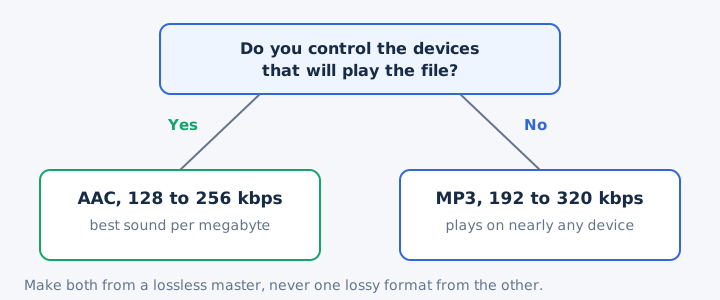
Keep a lossless master and make AAC or MP3 copies from it, never one lossy format from the other.
Is a 256 kbps AAC as Good as a 320 kbps MP3?
Yes, by Apple's own measure: Apple sells 256 kbps AAC as iTunes Plus and calls it indistinguishable from the original recording, and MP3 tops out at 320 kbps, so both sit near the top of their scales. The 256 kbps AAC takes 1.92 MB per minute against 2.4 MB for the 320 kbps MP3, so it is 20% smaller. No public test cited here compares those two exact settings. The 320kbps MP3 guide covers the top MP3 rate.
Should You Convert Your MP3 Files to AAC?
No, converting an MP3 to AAC stacks a second lossy encode on the first, so the AAC keeps every MP3 artifact and adds its own. Each re-encode adds generation loss. Only a new encode from the CD or a lossless master provides AAC's advantage. The guide to compress audio explains when shrinking a file costs quality.
Is It Worth Turning AAC Into MP3 for an Older Player?
Yes, when the player cannot read AAC: pick an MP3 bitrate at least as high as the AAC's, and 192 kbps suits most files. mp4tomp3.io converts .aac and .m4a files to MP3 at 128 to 320 kbps inside your browser without uploading them, and it can trim the clip first. It does not write AAC files.
A 320 kbps MP3 made from a 96 kbps AAC only gives a bigger file for an older player. Use the AAC to MP3 converter to make the copy.
Is AAC the Better Pick for iPhone and AirPods Users?
Yes, in most cases: the iPhone plays AAC natively and AirPods receive audio over the Apple AAC Bluetooth Codec, though the iPhone plays MP3 just as well. AAC music usually arrives as .m4a files, and the M4A to MP3 converter turns them into MP3 when another device needs them. Bluetooth is not lossless, whichever file you start from.
Is Opus Better Than Both AAC and MP3?
Yes, at low and middle bitrates: Opus 1.1 scored 4.65 at about 107 kbps in the 2014 listening test, ahead of Apple AAC at 4.40 and LAME MP3 at 4.24. Opus keeps its lead at low bitrate settings too. It has narrower device support than MP3, so it suits web and voice uses more than old players. The Opus audio format guide covers where it plays.