An AMR file stores a mobile phone's voice recording in about a tenth of the space of an MP3. AMR is short for Adaptive Multi-Rate, the speech codec that 3GPP made standard for phone calls, and it comes in narrowband and wideband types.
Eight fixed bitrates and ACELP coding squeeze speech hard. Inside, a 6-byte header leads a chain of 20 ms frames, and one minute takes about 96,000 bytes. The sound stays clear but phone-like.
Phone recorders and voicemail produce AMR files, VLC and Android play them, and most browsers cannot, so converting means decoding first. For how AMR fits beside MP3, WAV and FLAC, see the audio file formats guide.
What Is an AMR File?
An AMR file is an audio file that holds speech compressed with the Adaptive Multi-Rate codec, the 3GPP standard speech codec for mobile phones, at 4.75 to 12.2 kbit/s. The European standards body ETSI first standardized AMR for GSM networks, and 3GPP then chose it as the mandatory speech codec for 3G phones.
The name covers two things. AMR is the speech codec that turns a voice into a few kilobits per second, and a .amr file is the container that stores those bits on disk. RFC 4867, the IETF document for AMR, defines that storage format and gives it the .amr file type.
3GPP keeps the codec in specification TS 26.071, first published in Release 1999 and still maintained for today's networks. The Library of Congress describes AMR as a file format that many phones use for short spoken recordings.
What Are AMR-NB and AMR-WB?
AMR-NB and AMR-WB are the narrowband and wideband versions of the same speech codec. AMR-NB, the original AMR, samples speech at 8 kHz in eight modes from 4.75 to 12.2 kbit/s. AMR-WB samples at 16 kHz in nine modes from 6.60 to 23.85 kbit/s and carries a wider 50 to 7,000 Hz band. Two codecs share the AMR name, and they differ on these five points.
| Property | AMR-NB | AMR-WB |
|---|---|---|
| Sample rate | 8 kHz | 16 kHz |
| Modes | 8 | 9 |
| Bitrate range | 4.75 to 12.2 kbit/s | 6.60 to 23.85 kbit/s |
| File extension | .amr | .awb |
| Specification | 3GPP TS 26.071 and 26.090 | 3GPP TS 26.171 (ITU-T G.722.2) |
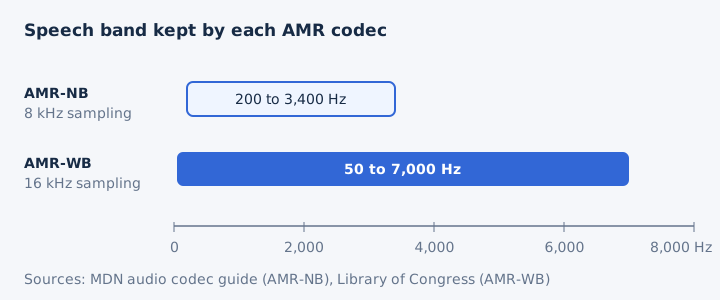
AMR-WB uses the higher sample rate to keep more of a voice. ITU-T publishes the same wideband codec as Recommendation G.722.2. Some guides quote 12.65 kbit/s as the bottom of AMR-WB, but that figure is one of its modes. The lowest AMR-WB mode is 6.60 kbit/s.
What Bitrates Does AMR Use?
AMR-NB codes speech at one of eight fixed bitrates: 4.75, 5.15, 5.90, 6.70, 7.40, 7.95, 10.2 or 12.2 kbit/s. The encoder can switch codec mode from one 20 ms speech frame to the next, so a single call can move up and down this list. Each mode packs a fixed number of bits into every frame, and three of them began life as separate phone standards.
| Mode (kbit/s) | Bits per frame | Also known as |
|---|---|---|
| 12.2 | 244 | GSM-EFR |
| 10.2 | 204 | none |
| 7.95 | 159 | none |
| 7.40 | 148 | IS-641 (TDMA) |
| 6.70 | 134 | PDC-EFR |
| 5.90 | 118 | none |
| 5.15 | 103 | none |
| 4.75 | 95 | none |
On a live call the network sets the mode through link adaptation, giving up speech bits when the radio signal needs more error protection. MDN rates the 7.4 kbit/s level as telephony-grade quality. A SID frame, the small frame sent during silence, holds only 39 bits.
AMR offers only these eight steps, and the top one, 12.2 kbit/s, sits about ten times below the 128 kbps of a common MP3. Our guide to bitrate in audio files explains how the number links to size and sound in every format.
How Does AMR Compress Speech?
AMR cuts speech into 20 ms frames, models each frame with linear prediction and an algebraic codebook, and sends almost nothing during silence. That speech model is called ACELP, short for Algebraic Code Excited Linear Prediction. Four steps turn a voice into a few kilobits per second.
- Framing: the encoder takes 160 samples, exactly one 20 ms frame at 8 kHz, as its working unit.
- ACELP coding: a filter from linear prediction plus a codebook index replaces each frame's raw waveform data.
- Voice activity detection: the encoder checks every frame and marks the ones that carry no speech at all.
- Discontinuous transmission: silent stretches become small SID frames, and the decoder plays matching comfort noise between words.
This speech model is how AMR fits a voice into 4.75 to 12.2 kbit/s, and it spends no bits on anything but speech. MP3 and AAC handle music as well as speech, and the guide to audio compression covers how those formats shrink sound.
What Is Inside an AMR File?
An .amr file holds a short text header, "#!AMR" plus a newline (6 bytes), followed by speech frames in time order. Every stored frame opens with a one-byte frame header that names its mode, so a player knows how many speech bits follow. RFC 4867 sets four magic number forms, and each one tells a player which kind of AMR file it has opened.
| Header text | Bytes | File type |
|---|---|---|
| #!AMR plus newline | 6 | Single-channel AMR-NB |
| #!AMR-WB plus newline | 9 | Single-channel AMR-WB |
| #!AMR_MC1.0 plus newline | 12 plus 4 | Multi-channel AMR-NB |
| #!AMR-WB_MC1.0 plus newline | 15 plus 4 | Multi-channel AMR-WB |
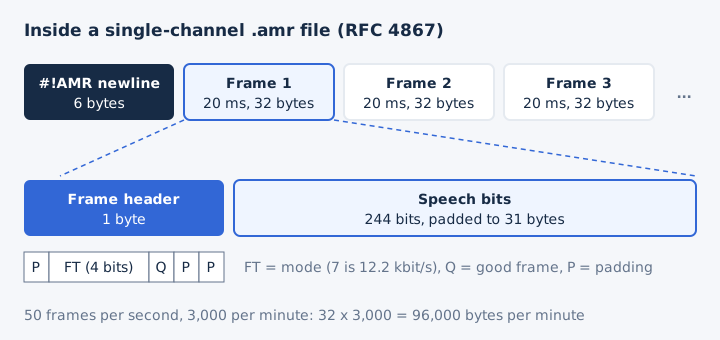
The frame header packs a 4-bit frame type field, which carries the mode number, and a quality bit, padded to a full byte. The speech bits come next, filled with zeroes up to the last whole byte. At 12.2 kbit/s that makes 31 bytes of speech plus the header, or 32 bytes per frame.
The codec itself codes one channel. In the multi-channel storage format, each frame block holds one frame per channel, and the extra 4 bytes after the magic number give the channel count.
Which File Extensions Does AMR Use?
AMR-NB audio uses the .amr file extension, and AMR-WB uses .awb. Both codecs can also sit inside a .3gp file, the 3GPP container that phones use for audio and video. Three extensions can carry AMR speech.
| Extension | Holds | Media type |
|---|---|---|
| .amr | AMR-NB speech | audio/AMR |
| .awb | AMR-WB speech | audio/AMR-WB |
| .3gp | AMR, other audio or video | audio/3GPP or video/3GPP |
The .3gp format follows 3GPP TS 26.244, an ISO-based file format that adds random access and keeps audio in sync with video. A plain .amr file has none of that structure. It runs from the header to the last frame.
Check the letters carefully when a file won't open. A .3gp from a phone is a container, so it may hold video as well as AMR sound, and it needs a player that reads the container.
How Big Is an AMR File?
One minute of AMR at the top 12.2 kbit/s mode takes 96,000 bytes, about 0.1 MB. That is a tenth of a 128 kbps MP3 and about 1/110 of a CD-quality WAV. One minute and one hour of speech show the gap.
| Format | Per minute | Per hour |
|---|---|---|
| AMR 4.75 kbit/s | 0.039 MB | 2.3 MB |
| AMR 12.2 kbit/s | 0.096 MB | 5.76 MB |
| AMR-WB 23.85 kbit/s | 0.183 MB | 11 MB |
| MP3 128 kbps | 0.96 MB | 57.6 MB |
| WAV 16-bit 44.1 kHz stereo | 10.6 MB | 635 MB |
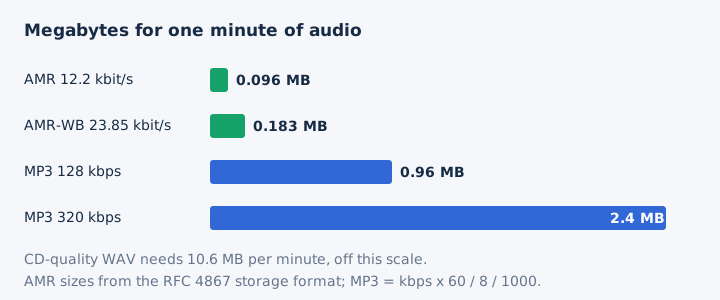
The math is simple once you count frames. A 20 ms frame means 50 frames per second, or 3,000 frames per minute. At 12.2 kbit/s each frame takes 32 bytes, and 32 times 3,000 gives 96,000 bytes, or 96 kilobytes.
Real recordings often come out smaller. Pauses between words become SID frames instead of full speech frames, so a slow talker's file uses less storage than the table shows.
How Good Is AMR Audio Quality?
AMR keeps speech clear but sounds like a phone call. AMR-NB uses a frequency band of only 200 to 3,400 Hz, which is telephone quality, and MDN calls the codec essentially useless for music, even for a singing voice alone.
AMR-WB widens that band to 50 to 7,000 Hz. That's why wideband calls and AMR-WB voice notes sound fuller and less boxy.
Both codecs are lossy and mono. AMR-NB stores 13-bit samples at 8 kHz, a sample rate far below the 44.1 kHz of a CD.
Apps that save messages as AMR trade sound for size on purpose. For how bitrate, band and format shape what you hear, see the guide to audio quality.
Where Do AMR Files Come From?
AMR files come mostly from phones. Voice recorders, voicemail and messaging apps save speech as AMR because it is tiny, and Android can record straight to .amr or .3gp. Four sources produce AMR files.
- Phone voice recorders: the Library of Congress notes that many handsets store short spoken recordings as AMR.
- Voicemail: MDN names voicemail and other short recordings as typical uses of the AMR codec.
- Messaging: RFC 4867 lists messaging, streaming and VoIP among the applications that use AMR audio.
- Android apps: MediaRecorder lets any voice recorder or call recording app write AMR_NB, AMR_WB or 3GPP files.
Android encodes and decodes both AMR-NB and AMR-WB. The AMR_NB and AMR_WB output formats arrived in Android API level 10, and the older RAW_AMR option was retired in API level 16.
How Do You Open an AMR File?
VLC media player opens AMR files on Windows, Mac and Linux, Android phones play them natively, and FFmpeg decodes them. Chrome, Firefox and Opera cannot play them. Support depends on the player more than on the computer.
| Player or platform | Plays AMR | Note |
|---|---|---|
| VLC media player | Yes | Lists AMR (3GPP) |
| Android | Yes | Built-in AMR-NB and AMR-WB decoders |
| FFmpeg | Yes | Built-in AMR-NB and AMR-WB decoding |
| Chrome, Firefox, Opera | No | Per MDN's codec table |
| ChromeOS | Yes | AMR-NB and AMR-WB |
| Windows Media Player | Not listed | Its list names .3gp, not .amr |
| iPhone | Not listed | Apple names AAC, MP3, FLAC and others |
For an iPhone, Apple's iPhone 16 spec sheet names AAC, APAC, MP3, Apple Lossless, FLAC and Dolby formats and doesn't name AMR. The list says "include", so it isn't complete, but the reliable route is to convert the file on a computer first.
How Do You Convert an AMR File?
You convert an AMR file by decoding it with a program that reads AMR, such as FFmpeg, and writing the sound as WAV or MP3. The new file plays everywhere but keeps the phone-call sound of the original. mp4tomp3.io has no AMR input today, so the decoding step happens in another program. Pick WAV for editing or transcription, since it needs no re-encoding, and MP3 for sharing.
Can mp4tomp3.io Convert an AMR File?
No, mp4tomp3.io does not read AMR, because it relies on the browser decoder, and Chrome and Firefox cannot decode AMR. The working route has two steps: decode the .amr to WAV with FFmpeg, then convert that WAV to MP3 with the WAV to MP3 converter, which never uploads the file. mp4tomp3.io reads WAV files directly, so the second step stays on your device.
Does Converting AMR to MP3 Improve the Sound?
No, an MP3 made from an AMR file keeps the AMR's narrow phone sound, because the detail the AMR encoder dropped never comes back. Apple sets the same rule for any lossy source: a format change adds no quality. An MP3 at 128 kbps is about ten times larger than a 12.2 kbit/s AMR, with no gain. Read what MP3 is to choose a sensible bitrate for speech.
Is WAV a Better Target Than MP3 for an AMR Recording?
Yes, for editing or transcription, because WAV stores the decoded samples without a second lossy step, and an 8 kHz mono WAV takes only 0.96 MB per minute. A WAV resampled to 44.1 kHz stereo grows to 10.6 MB per minute and adds no detail. The WAV file guide covers sample rates and sizes in full.
Can a Web Browser Play an AMR File?
No, Chrome, Firefox and Opera play no AMR audio, according to MDN's codec support table, although ChromeOS plays AMR-NB and AMR-WB. That gap is why online players and browser converters either ask you to upload the file or fail on it. The audio codec guide explains why a browser's codec list decides what it can play.