EAC3 packs up to 7.1 channels of film and TV surround sound into a few hundred kilobits per second. Dolby Laboratories sells this audio codec as Dolby Digital Plus, and the standards call it E-AC-3. Its lossy compression shrinks a 7.1 track at 384 kbps to one sixteenth of raw PCM.
EAC3 goes by five labels, and Dolby first presented it in 2004. It codes 256-sample blocks with tools that AC-3 lacks, tops out at 6,144 kbps, and adds programs, channels and Dolby Atmos. Old Dolby Digital decoders cannot read it. Blu-ray, digital TV, streaming services, Apple devices and VLC all use it, and you convert it only when a device refuses it. EAC3 sits among the wider family of audio file formats.
What Is the EAC3 Audio Format?
EAC3 is a lossy multichannel audio codec from Dolby Laboratories that extends Dolby Digital (AC-3). Its full name is Enhanced AC-3, and Dolby markets it as Dolby Digital Plus. Two standards define it: ETSI TS 102 366, in its Annex E, and ATSC A/52, also in Annex E.
The codec carries multichannel audio for film, TV and streaming. Dolby lists up to 7.1 discrete channels and bitrates from 32 kbps to about 6 Mbps. EAC3 samples sound at 48, 44.1 or 32 kHz.
EAC3 names the sound, not the file. An MKV, MP4 or TS video file holds the EAC3 track next to the picture, so "EAC3 file" usually means a video whose audio track uses this codec.
Are EAC3, E-AC-3 and Dolby Digital Plus the Same Thing?
Yes, EAC3, E-AC-3, Enhanced AC-3, Dolby Digital Plus and DD+ all name one codec. Standards, brands, file formats and apps simply print different labels for it. Each label below points to the same Dolby codec.
- E-AC-3
- The name ETSI and ATSC use in their audio coding standards for Enhanced AC-3.
- Dolby Digital Plus (DD+)
- Dolby's product name for the codec, often shortened to DD+ on device spec sheets.
- EAC3
- The short label many media players and file tools show for the audio track.
- ec-3
- The MP4 sample entry code that marks an Enhanced AC-3 track inside an MP4 file.
- A_EAC3
- The Matroska codec ID that marks an EAC3 track inside an MKV file.
AC-3, sold as Dolby Digital, is the older codec of the same family, and the AC-3 format has its own guide. Android's audio API names the newer codec ENCODING_E_AC3.
When Did Dolby Introduce EAC3?
Dolby Laboratories presented Dolby Digital Plus at the 117th AES Convention in San Francisco in October 2004, as an extension of its AC-3 coding system. ATSC and ETSI later wrote it into their audio standards. Four documents trace EAC3 from a conference paper to a standard.
| Date | Event |
|---|---|
| October 2004 | Dolby presents Dolby Digital Plus at the AES Convention |
| December 2012 | ATSC A/52:2012 covers both AC-3 and E-AC-3 |
| September 2017 | ETSI TS 102 366 V1.4.1 defines AC-3 and E-AC-3 |
| October 2018 | ETSI TS 103 420 V1.2.1 adds Atmos objects to E-AC-3 |
Dolby had two reasons to build it. IPTV and other bandwidth-tight broadcast formats needed a more efficient codec. Digital cinema also mixed more speaker channels than the 5.1 that Dolby Digital could deliver at home. The Advanced Television Systems Committee published A/52:2012 on 17 December 2012, and ETSI TS 102 366 also covers carriage in MP4, MPEG-DASH and CMAF. ATSC A/52:2012 defines E-AC-3 in its Annex E.
How Does EAC3 Compress Audio?
EAC3 compresses audio the way AC-3 does, by turning blocks of 256 samples into frequency data and spending bits only where the ear notices. Dolby then added new coding tools, and its technical paper says they need about half the data rate of Dolby Digital. Four tools separate EAC3 from the AC-3 it grew from.
- Hybrid transform: turns six 256-sample blocks into one 1,536-coefficient block, giving steady sounds finer frequency detail.
- Enhanced channel coupling: shares high frequencies across channels and keeps their phase, so coupling reaches lower frequencies.
- Spectral extension: rebuilds the highest frequencies from lower ones, so the encoder stores less treble data.
- Transient pre-noise processing: shortens the faint pre-noise that lossy coding leaves just before a sharp sound.
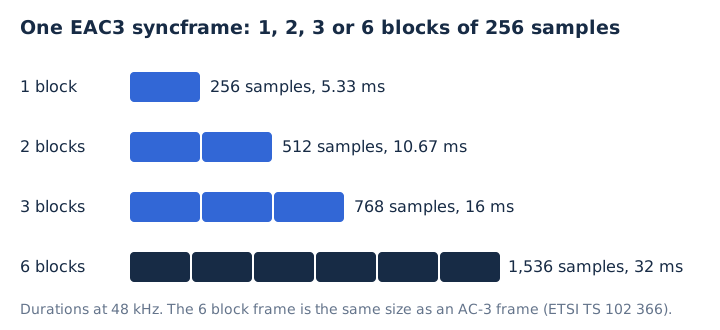
Each syncframe holds 1, 2, 3 or 6 audio blocks. At 48 kHz that sets a frame length of 5.33 to 32 ms. The AC-3 standard shows the scale of the saving: its example turns 5,184 kbps of 5.1 PCM into a 384 kbps stream.
What Are the EAC3 Specifications?
EAC3 runs from 32 kbps to 6,144 kbps, samples at 48, 44.1 or 32 kHz, and carries up to 7.1 channels in today's products. One stream can also pack up to 8 independent programs. The standard sets these limits.
| Property | EAC3 value |
|---|---|
| Bitrate | 32 to 6,144 kbps |
| Sample rate | 48, 44.1 or 32 kHz |
| Channels | Up to 7.1 today, 13.1 or more by design |
| Frame size | 1, 2, 3 or 6 blocks of 256 samples |
| Programs | Up to 8 independent substreams, each with up to 8 dependent ones |
| Compression | Lossy |
A substream is a separate program or channel group inside one EAC3 track. An independent substream plays on its own, such as a second language. A dependent substream adds channels to its main program, which is how a 5.1 core grows to 7.1.
What Is the Difference Between AC3 and EAC3?
EAC3 keeps AC-3's framing and metadata but raises every limit: up to 6,144 kbps instead of 640 kbps, more than 5.1 channels, shorter frames and extra programs. So EAC3 and AC3 are not the same codec; EAC3 is the newer member of the Dolby Digital family. Side by side, the two Dolby codecs differ on six points.
| Feature | AC-3 (Dolby Digital) | EAC3 (Dolby Digital Plus) |
|---|---|---|
| Top bitrate | 640 kbps | 6,144 kbps |
| Channels | Up to 5.1 | Up to 7.1 today |
| Frame | 6 blocks (32 ms) | 1, 2, 3 or 6 blocks |
| Programs per stream | 1 | Up to 8 |
| Dolby Atmos | No | Yes, with JOC |
| Decoder plays | AC-3 only | EAC3 and AC-3 |
AC-3 tops out at 5.1 channels: five full-range speakers plus one LFE channel for deep bass. EAC3 keeps that layout as its base and adds channels on top.
Can Older Dolby Digital Equipment Play EAC3?
No, an AC-3-only decoder cannot decode an EAC3 stream, ETSI TS 102 366 says, while every EAC3 decoder must also play AC-3. Backward compatibility therefore runs one way. Dolby built two routes around the gap.
A Blu-ray Disc DD+ track carries a 5.1 Dolby Digital core frame plus an extension frame, so a basic player decodes the core and plays 5.1. Broadcast gear repackages DD+ into a 640 kbps Dolby Digital stream without decoding and re-encoding it. That repack feeds an older A/V receiver over S/PDIF or HDMI.
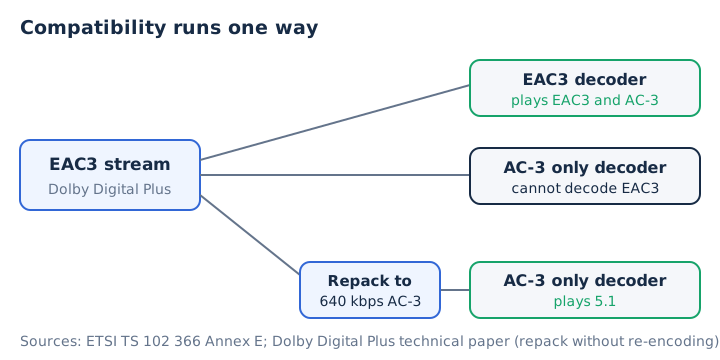
The repack can beat a DVD on the same receiver. DVD-Video carries Dolby Digital at no more than 448 kbps, while the repack runs at 640 kbps.
How Does EAC3 Carry Dolby Atmos?
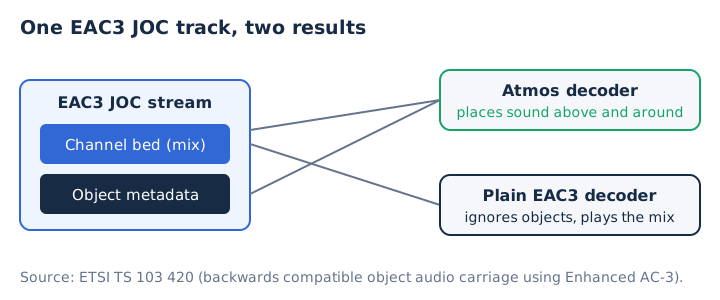
EAC3 carries Dolby Atmos through Joint Object Coding (JOC), which adds object metadata to a normal channel mix. ETSI TS 103 420 defines this extension and requires it to stay backward compatible. The channel bed stays a standard EAC3 mix, and the objects ride alongside it. The same EAC3 track gives two results.
- Atmos decoder: reads the object metadata and places each sound above and around the listener.
- Plain EAC3 decoder: skips the object metadata and plays the channel bed as normal surround.
Android labels these tracks ENCODING_E_AC3_JOC from API level 28, and its documentation says devices that support E-AC-3 decode them. MP4 files still mark Atmos tracks as ec-3, because the separate ec+3 code was withdrawn. Not every EAC3 track carries Atmos: only a JOC track does.
What Bitrates Do Platforms Use for EAC3?
Dolby rates EAC3 at 32 kbps to 6 Mbps and names 384 kbps for discrete 7.1 sound. Blu-ray Disc allows up to about 1.7 Mbps: 640 kbps for the core plus 1,024 kbps for the extension. Each bitrate turns into a file size per minute.
| Track | Bitrate | MB per minute |
|---|---|---|
| DD+ 7.1 (Dolby figure) | 384 kbps | 2.88 MB |
| DVD Dolby Digital maximum | 448 kbps | 3.36 MB |
| AC-3 maximum | 640 kbps | 4.8 MB |
| Blu-ray DD+ maximum | 1,664 kbps | 12.48 MB |
| 7.1 PCM, 16-bit, 48 kHz | 6,144 kbps | 46.08 MB |
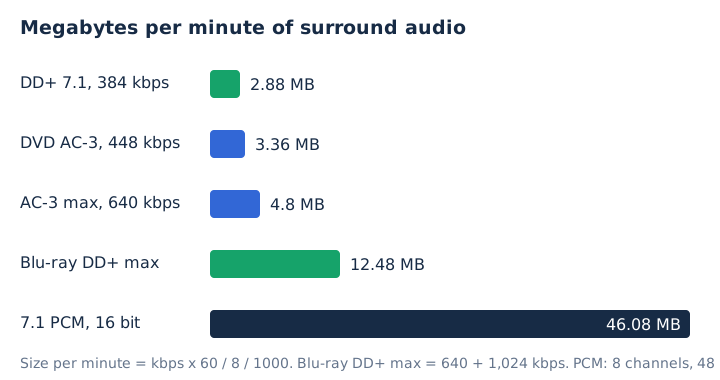
The last row explains the saving. Eight channels of 16-bit PCM at 48 kHz run 6,144 kbps. A 384 kbps DD+ track is one sixteenth of that, so the file size drops by 16 times for the same 7.1 surround layout.
Where Is EAC3 Audio Used?
EAC3 audio is used on Blu-ray Disc, in ATSC and DVB digital TV, on streaming services, and inside MKV, MP4 and MPEG transport stream files. Dolby names Netflix, Vudu and Amazon Fire TV among the streaming platforms. Four places hold most EAC3 audio.
- Blu-ray Disc: stores 7.1 DD+ tracks with a 5.1 Dolby Digital core for basic players.
- Digital TV: carries DD+ in ATSC and DVB broadcasts, where it saves bandwidth over AC-3.
- Streaming: delivers adaptive bit-rate DD+ audio to TVs, streaming sticks, PCs and phones.
- Video files: holds EAC3 tracks in MKV (A_EAC3), MP4 (ec-3) and MPEG-TS containers.
ETSI TS 102 366 also covers EAC3 in MPEG-DASH and CMAF streaming. The MKV file guide covers the Matroska container itself.
Which Apps and Devices Support EAC3?
Apple devices, Windows 10 with Microsoft Edge, VLC, and home theater gear with Dolby Digital Plus decode EAC3. Support sits in the device or player, not in the file.
| Platform | Plays EAC3 | Source |
|---|---|---|
| iPhone, iPad, Mac, Apple TV | Yes, built in | Apple, Dolby |
| Windows 10, Microsoft Edge | Yes, built in | Dolby |
| VLC (desktop) | Yes, own decoder | VideoLAN |
| Android | Depends on phone and app | Android API |
| Receiver, TV, soundbar | Models with Dolby Digital Plus | Dolby |
Dolby lists iOS, macOS and tvOS support, so an iPhone or Apple TV plays EAC3 without extra software. VLC ships its own E-AC-3 decoder on the desktop. On Android, the system names the format, but the phone and the player app decide whether sound comes out.
There is no separate EAC3 format to download. The decoder lives inside the player, the operating system or the receiver. If a phone app shows the "audio format EAC3 not supported" message, the EAC3 not supported guide covers that error and its fixes.
When Should You Convert EAC3 Audio to Another Format?
Convert EAC3 only when the device or app that must play it cannot decode it, such as an AC-3-only receiver or a music player that reads MP3 or AAC. Keep EAC3 when your TV, receiver or player decodes it. Each lossy conversion drops more detail, and a stereo target drops the surround channels too, so compatibility is the only good reason to convert.
mp4tomp3.io usually can't read EAC3 sound, because browsers don't decode it. A desktop player such as VLC is the practical route for those files.
Can an Online Converter Change EAC3 Audio to MP3?
No, not in the browser in most cases: browsers do not decode EAC3, so mp4tomp3.io shows an error message for a video with EAC3 sound instead of making a silent MP3. An MKV file with AAC, Opus, Vorbis, MP3 or FLAC sound does convert, at 128 to 320 kbps and without upload, through the MKV to MP3 converter.
Does Converting EAC3 to MP3 Keep the Surround Channels?
No, an MP3 file holds at most 2 channels, so a 5.1 surround or 7.1 EAC3 track becomes a stereo downmix. MPEG-1 MP3 carries 2 channels at most, as the MP3 format guide explains. AAC allows up to 48 channels when the surround layout has to survive.
Is EAC3 Lossless Like TrueHD?
No, EAC3 is lossy: Dolby lists Dolby Digital Plus as lossy and Dolby TrueHD as its lossless format. A lossy codec removes audio data for good, so converting EAC3 to WAV or FLAC never replaces the lost data. Dolby TrueHD stores lossless audio, and only a true lossless audio source keeps every sample.
Is EAC3 Better Than AAC?
No, neither wins in every case: EAC3 suits surround sound for TVs and receivers, while AAC samples at up to 96 kHz against EAC3's 48 kHz and plays on iPhone and Android phones. Pick AAC or MP3 for phones and music players, and keep EAC3 for the home theater. The AAC format guide covers AAC in detail.
Does Converting an EAC3 Atmos Track Keep Dolby Atmos?
No, a converter without JOC support outputs only the channel mix, so Dolby Atmos object metadata never reaches the MP3, WAV or AAC file. A stereo MP3 allows only two channels, so the Atmos height effects vanish and the plain mix remains. EAC3 is one of many audio file formats, and each one trades size, quality and device support differently.